

Polyvinylpyrrolidone, also known as PVP, has a CAS number of 9003-39-8. PVP is a fully synthetic water-soluble polymer compound formed by the polymerization of N-vinylpyrrolidone (NVP) under certain conditions. At the same time, PVP has excellent solubility, chemical stability, film-forming properties, low toxicity, physiological inertness, water absorption and moisture retention, adhesion, and protective adhesion. It can be used as an additive, auxiliary agent, and auxiliary material in combination with many inorganic and organic compounds.
Polyvinylpyrrolidone (PVP) is traditionally used in various fields such as medicine, cosmetics, food and beverage, brewing, textiles, and separation membranes. With the development of new technology products, PVP has been applied to high-tech fields such as photocurable resins, optical fibers, laser discs, and drag reduction materials. PVP of different purities can be divided into four grades: pharmaceutical grade, daily chemical grade, food grade, and industrial grade.
The main reason why PVP can be used as a coprecipitant is that the ligands in the PVP molecules can combine with the active hydrogen in the insoluble molecules, which, on the one hand, makes the relatively small molecules become amorphous and enter the PVP macromolecules. On the other hand, the hydrogen bonding does not change the water solubility of PVP, so the result is that the insoluble molecules are dispersed in the PVP macromolecules through hydrogen bonding, making it easy to dissolve. There are many types of PVP. How to choose when choosing? When the amount (mass) of PVP is the same, the increase in solubility decreases in the order of PVP K15>PVP K30>PVP K90. This is because the solubilization effect of PVP itself changes in the order of PVP K15>PVP K30>PVP K90. Generally, pVp K 15 is more commonly used.
About the formation of PVP: Only NVP monomer participates in the polymerization, and its product is polyvinyl pyrrolidone (PVP). The NVP monomer undergoes a self-crosslinking reaction or the NVP monomer undergoes a crosslinking copolymerization reaction with a crosslinking agent (a compound containing multiple unsaturated groups), and the product is polyvinyl pyrrolidone (PVPP). It can be seen that by controlling different polymerization process conditions, various polymerization products can be generated.
We understand the process flow of PVP:
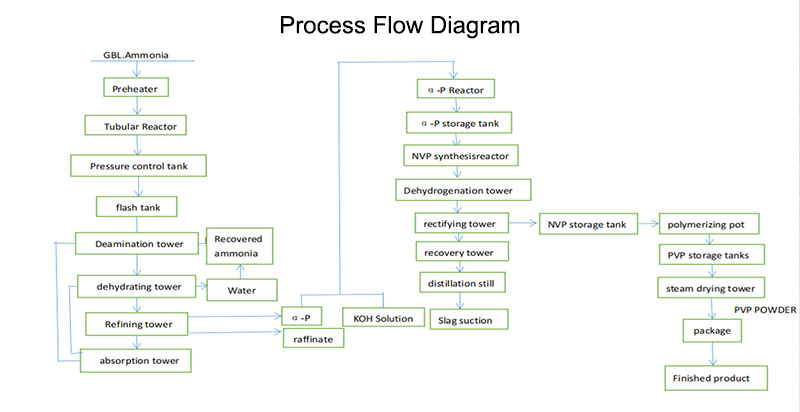
Uses of industrial grade PVP: PVP-K series can be used as film former, thickener, lubricant, adhesive in daily chemical products, used in hair spray, mousse, hair spray, setting agent, etc.; PVP can be added to hair dye, as a modifier in skin care products, as a foam stabilizer in shampoo, as a dispersant in wave setting agent, and as an affinity agent. It can enhance the wetting and lubrication effect in face cream and sunscreen; secondly, adding PVP to detergent has a good anti-color effect and can enhance the decontamination ability.
Application of PVP in industry and high-tech fields: PVP can be used as a surface coating agent, dispersant, thickener, adhesive, etc. in pigments, printing inks, textiles, printing and dyeing, color picture tubes, which can improve the bonding performance of adhesives to metals, glass, plastics and other materials. In addition, PVP is also increasingly widely used in emerging high-tech fields such as separation membranes, ultrafiltration membranes, microfiltration membranes, nanofiltration membranes, oil exploration, photocurable resins, paints and coatings, optical fibers, laser video discs, etc.
Application of pharmaceutical grade PVP: In the PVP-K series, k30 is one of the synthetic excipients used, mainly used as production agents, adhesives for microparticles, sustained-release agents, excipients and stabilizers for injections, flow aids, dispersants and colorants for liquid preparations, stabilizers for enzymes and thermosensitive drugs, coprecipitants for difficult-to-tolerate drugs, fillers for ophthalmic lubricants, coating film-forming agents, etc.
Polyvinyl pyrrolidone and its polymers, as new fine chemical materials, are widely used in medicine, food, daily chemicals, printing and dyeing, pigment coatings, biomaterials, water treatment materials and other fields, and have broad market application prospects. After years of continuous exploration, we have developed a variety of polymer products, including:
| Product Name | CAS No. |
| Polyvinylpyrrolidone/PVP K12/15/17/25/30/60/90 | 9003-39-8 |
| Polyvinylpyrrolidone cross-linked/PVPP | 25249-54-1 |
| Poly(1-vinylpyrrolidone-co-vinyl acetate)/VA64 | 25086-89-9 |
| Povidone iodine/PVP-I | 25655-41-8 |
| N-Vinyl-2-pyrrolidone/NVP | 88-12-0 |
| N-Methyl-2-pyrrolidone/NMP | 872-50-4 |
| 2-Pyrrolidinone/α-PYR | 616-45-5 |
| N-Ethyl-2-pyrrolidone/NEP | 2687-91-4 |
| 1-Lauryl-2-pyrrolidone/NDP | 2687-96-9 |
| N-Cyclohexyl-2-pyrrolidone/CHP | 6837-24-7 |
| 1-Benzyl-2-pyrrolidinone/NBP | 5291-77-0 |
| 1-Phenyl-2-pyrrolidinone/NPP | 4641-57-0 |
| N-Octyl pyrrolidone/NOP | 2687-94-7 |


