



Binder
Hangzhou Weitong Nanomaterials Co., Ltd. is an innovative enterprise focusing on the field of nanomaterials, founded in 2015. Our factory has an efficient production capacity and is able to produce a wide range of high-quality products. Our factory adopts a strict quality management system to ensure that the products meet high quality standards. We have a professional technical team and advanced production equipment, as well as perfect after-sales service, to provide customers with a full range of solutions. We strive for continuous innovation and optimization to meet and exceed our customers' needs and expectations, and move forward to become a world-class chemical company.


Why Choose US
Our factory:Hangzhou Weitong Nanomaterials Co., Ltd. is an innovative enterprise focusing on the field of nanomaterials, founded in 2015. Our factory has an efficient production capacity and is able to produce a wide range of high-quality products.
Our product:Our range of NVP-based products covers various series tailored to different industries. This includes the homopolymer series (K15-K120), copolymer series (VA64 powder, V64E, VA64W, 73W, 37E, 37W), and cross-linked series (PVPP XL-10, PVPP-10, povidone-iodine pvpI). These products find applications across diverse sectors, serving as stabilizers, dispersants, coatings, inks, and adhesives.
Quality control:We have the ISO9001 certificate, and we strictly follow GMP production standards for production.
Good after-sale service:We have a sound after-sales service system, so whatever you have any doubt about the product, you can strictly contact us, we will give you a satisfied plan.
What is Crospovidone
Crospovidone, a pharmaceutical excipient, is a water-insoluble synthetic cross-linked N-vinyl-2-pyrrolidone homopolymer. pients and active ingredients have very good compatibility. Solid drugs containing PVPP tablet disintegrants can use common tablet production techniques, including direct compression, It is easy to produce by spraying, drying and wet granulation.
Compressibility and adhesion
Crospovidone nf has excellent fluidity and plastic deformation, so they have excellent adhesion. This property gives good compressibility in spraying, drying, and wet granulation. Adding PVPP tablet disintegrant to the tablet, compared with commonly used starch, cellulose preparations and pectin compounds, the hardness and abrasion resistance of the tablet are not affected, and the capping of the tablet is not reduced. Crospovidone nf can also be effectively used as a tablet disintegrant in direct compression, without the use of lubricants or the addition of binders.
Capillary activity and hydration capacity
Research work has shown that PVPP as a tablet disintegrant has high capillary activity and hydration capacity, because of their large specific surface area (average 1.25 m2/g) and significant water absorption (high and rapid water absorption) , Up to 60% or more).
Swelling and disintegration
PVPP has high capillary activity, so it can quickly absorb water into the tablet. Because the internal pressure (swelling pressure) exceeds the strength of the tablet, the tablet disintegrates instantly. And because there are folded molecular chains between the crosslinks, when water or aqueous solution penetrates, they are stretched by sudden impact and forced to separate immediately. As a result of swelling, the net volume increases (approximately doubled in 5 minutes), so that tablets prepared with PVPP tablet disintegrants disintegrate immediately.
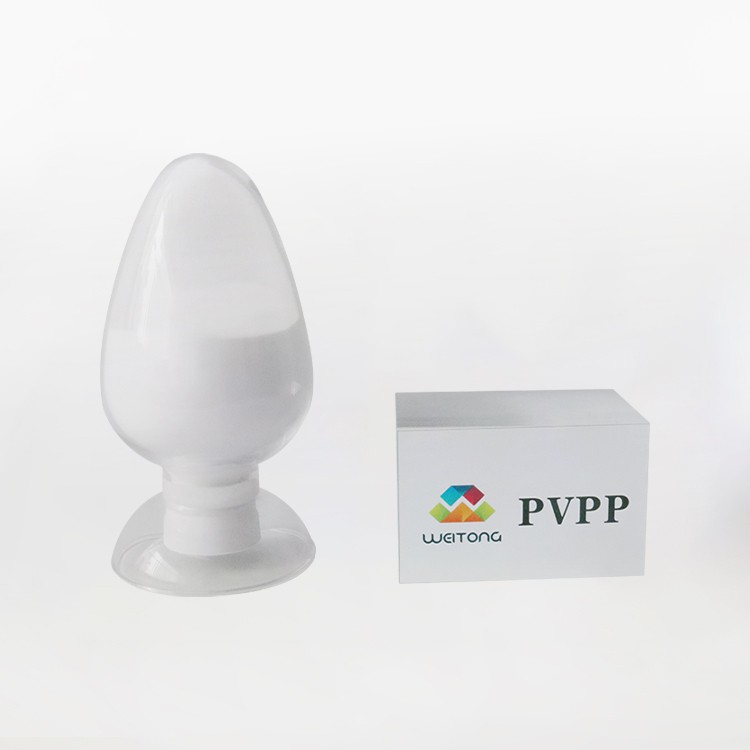
Crospovidone is an insoluble form of polyvinylpyrrolidone, and its use in the pharmaceutical industry as a tablet excipient (a tablet disintegrant and binder) has been widely documented. It is medically used for the treatment of some intestinal disorders as solubilizing excipients to improve the bioavailability of drugs (such as steroids) and as germicides in wound treatment. It is also commonly used as a clarifier in alcoholic and nonalcoholic beverages. This chapter describes the methods of crospovidone preparation and discusses its physical properties and primary uses. The primary pharmaceutical application of crospovidone is that of a tablet disintegrant, although it can also function as a tablet binder. For a polymer to be useful as a pharmaceutical excipient, grades of material need to possess properties such as high swelling capacity, high capillary activity, high hydration capacity, and low bulk density. The chapter discusses the interactions of crospovidone with drug substances.
Cross-Linked Povidone Uses
Cross-linked povidone is a water-insoluble tablet disintegrant that quickly exhibits high capillary activity and excellent hydration ability, with almost no tendency to gel; studies have shown that the size of cross-linked povidone particles strongly affects Regarding the disintegration of antipyretic and analgesic tablets, crospovidone with larger particles can disintegrate faster than smaller particles. Crospovidone is a very good disintegrant. The dosage in tablets is generally 1-2%, which can achieve the disintegration effect of other commonly used ordinary disintegrants. It is called a super disintegrant.
Cross-linked povidone can also be used as a dry binder, filler and excipient for tablets, capsules and granules. The smaller particle size can reduce the markings on the tablet surface and improve the texture of the tablet. Uniformity, the usual dosage is 20-80mg/tablet.
Crospovidone can also be used as a dissolution accelerator. Co-evaporation technology can be used to increase the solubility of poorly soluble drugs: first, an appropriate solvent is used to adsorb the drug to crospovidone, and then the solvent is evaporated. This technology can Get faster dissolution rates.
This product is also widely used as a filter aid in wine making and vinegar production in the food industry to remove enzymes and proteins.
Cross-linked povidone and polyphenols can form stable complexes, which can be used to refine water-soluble or alcohol-containing herbal extracts and tinctures to improve the stability of plant medicines.
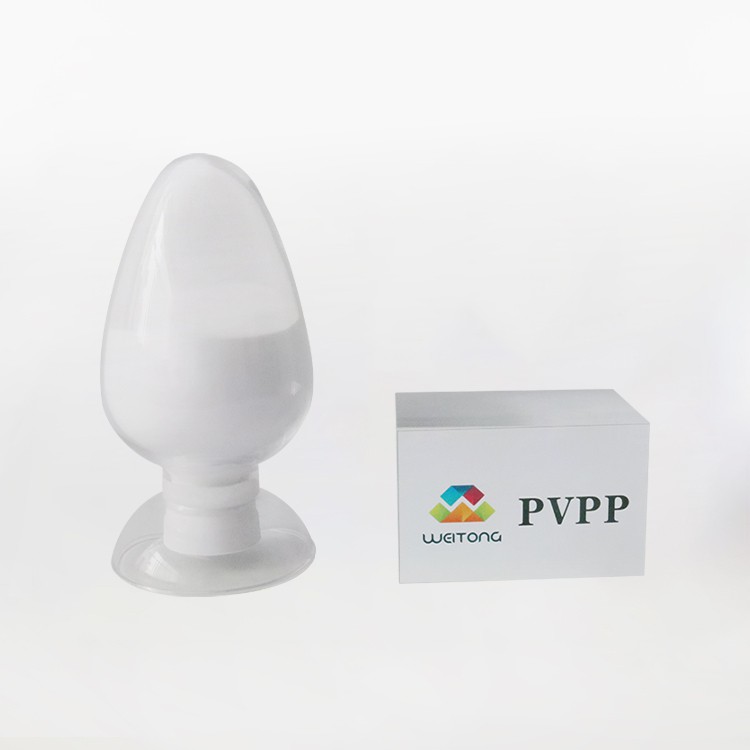
Crospovidone is a crosslinked and insoluble polyvinyl pyrrolidinone polymer. Owing to its insolubility and high swelling properties, it is used as a superdisintegrant. Unlike Povidone, it is not described in terms of a K-value or molecular weight, and instead, according to particle size. Crospovidone is supplied as a white or almost white, almost odourless hygroscopic powder.
Synonyms and Trade Names: Crosslinked Povidone; Crosslinked Polyvinylpyrrolidone; Insoluble Polyvinylpyrrolidone; Kollidone® CL; Crospovidone XL; PLASDONE™ XL
The main difference between Povidones and Crospovidone is that Crospovidone is manufactured by a polymerization process that results in a cross-linked povidone analogue. The reaction is undertaken in an aqueous medium and no organic solvents or radical starters are used. The cross-linking process is both chemical and physical, with the latter mechanism, which is achieved mainly via polymer chain entanglement, dominating the material's properties.
Owing to the insolubility of Crospovidone in all the standard solvents, it is not possible to describe the material in terms of a K-value or molecular weight. Instead, the different grades are differentiated mainly by the particle size distribution into two main types: Type A (Standard), and Type B (Fine, Superfine and Micronised). Their main differences are shown below:
|
Type A |
Type B |
|||
|
Grade |
Standard |
Fine |
Super Fine |
Micronised |
|
Particle size (µ) |
40 – 140 |
20-100 |
30 – 100 |
<10 |
|
Swelling pressure (kPa) |
170 |
30 |
25 |
70 |
Chemical Structure & Identifiers
|
Chemical Name |
1-Ethenyl-2-pyrrolidinone homopolymer |
|
CAS Registration Number |
[9003-39-8] |
|
Empirical Formula |
(C6H9NO)n |
|
Molecular weight |
Greater than 1 000 000 |
|
EINCES Number |
618-363-4 |
|
UNII Code (FDA) |
2S7830E561 |
Upon contact with water, Crospovidone absorbs water via capillary action and regains its normal structure releasing an amount of energy capable to break the tablet. The particle size of crospovidone strongly affects the disintegration process, and larger particles provide a faster disintegration. As particle size increases, the intra-particular porosity increases, leading to larger water uptake and faster disintegration.
In the presence of moisture, water molecules are absorbed into the porous structure of the material's agglomerates, which causes the lattice structure to expand. This causes high stress to build on surrounding core ingredients. This, in addition to the porous nature of the particles, allows the polymer to wick water, leading to disintegration of the tablet.
As a superdisintegrant, Crospovidone is recommended to be used at 2—5% as a proportion of the tablet weight, whether prepared by direct- compression or wet- and dry-granulation methods. Higher superdisintegrant levels do not necessarily lead to faster disintegration, and may indeed, lead to weaker tablets.
Generally, Crospovidone grades with larger average particles provide faster disintegration rates compared with grades with smaller particles. However, finer-grained grades or those with narrow particle size distributions are recommended for use for small tablets with low API concentrations.
Use of Crospovidone to Stabilise Suspensions
Micronised Crospovidone (Type B) can be added in concentrations of 5 - 12% to oral and topical suspensions to stabilise oral and topical formulations. This grade achieves this effect by increasing the volume of the sediment and reducing its sedimentation rate, and by making it easy to redisperse the sediment by shaking (anticaking effect). These effects are achieved without increasing the formulation's viscosity.
The ability to stabilise suspensions without increasing thickness is particularly useful in ready-to-use suspension or an instant drink-type powder or granulate formats that require the consumer to prepare before use.
The addition of electrolytes such as sodium citrate as well as xanthan gum or sugar syrups is recommended as it increases the sediment volume achieved with Crospovidone in these formulations.
Stability and Storage Conditions
Crospovidone is highly hygroscopic and absorbs significant amounts of moisture (25% water uptake at 75% RH). Storage conditions selected should prevent contact with the atmosphere for prolonged periods of time. Crospovidone has an expected shelf life is 3 years. Over time, residual peroxides increase, which can affect the stability of oxygen-sensitive molecules.
What is Polyvinylpyrrolidone K 90
Polyvinylpyrrolidone K-90 is a water-soluble polymer made up of repeating units of N-vinylpyrrolidone. It has a molecular weight of approximately 1,300,000 g/mol and is a white to slightly yellowish powder. It has a wide range of applications in various industries including pharmaceuticals, cosmetics, and food. It is used as a binder, emulsifier, thickener, and film former in tablet and capsule formulations in the pharmaceutical industry. In cosmetics, it is used as a hair fixative, film former, and emulsifier. In the food industry, it is used as a clarifying agent, emulsifier, and stabilizer. It is a versatile polymer with excellent solubility and biocompatibility making it highly valuable in various applications.
The Application Field of Polyvinylpyrrolidone K 90
Cosmetics
PVP has excellent surface activity, film-forming properties, no skin irritation, no allergic reaction, etc., and it has broad prospects in daily chemicals, especially in cosmetics, skin care products, hair care products and detergents. For example, the hair spray and mousse with PVP will last for a long time and have a good luster, and because PVP has a certain water absorption, it will make the hair moist and smooth without looking dull. Skin care products with PVP not only have a good moisturizing effect, but also the film formed on the skin surface can isolate the skin from the outside world (such as sunlight) and protect the skin.
Medicine
PVP has good solubility, solubility, physiological compatibility, bonding ability, and complexing ability. It is widely used in the field of medicine and health. It can be used as a binder, excipient, coating agent, Disintegrants, cosolvents, disinfectants, solubilizers, slow-release agents, capsule shells, dispersion stabilizers, film-forming agents, etc.
Clarifying agent; pigment stabilizer; colloidal stabilizer; It is mainly used for beer clarifying and quality stabilizing (reference amount 8~20g/100L, maintained for 24h and remove it by filtration), and can also be applied in combination with enzymes (protease) and protein adsorbents. It is also used to clarify the wine and as a stabilizer to prevent discoloration (reference amount 24~72g/100L).
Clarifying agents; stabilizers; thickeners agent; tablet fillers; dispersants; PVP of molecular weight 360,000 are often used as the clarifying agent of beer, vinegar, and grape wine.
Used as the fixing liquid for gas chromatography.
It is used as a colloidal stabilizer and clarifying agent for beer clarification. Apply proper amount according the demands of production.
It can be used for pharmacy, aquaculture, and livestock disinfectant for the sterilization of the skin and mucous.
PolyFilterTM molecule has an amide bond for absorbing the hydroxyl groups located in polyphenol molecule to form hydrogen bonds, and therefore, can be used as the stabilizer of beer, fruit wine/grape wine, and drinking wine to extend their shelf life and improve the transparency, color and taste. The products have two specifications: disposable type and regeneration type. Disposable products are suitable for application by SMEs; renewable products demand the purchase of special filtration equipment; but since it is recyclable, it is suitable for large breweries for recycle application.
Specification
|
Product Name |
Polyvinyl pyrrolidone |
|
|
CAS No. |
9003-39-8 |
|
|
Density |
1.144g/cm3 |
|
|
Molecular Formula |
C6H9NO |
|
|
Boiling point |
217.6°C |
|
|
Melting point |
130°C |
|
|
Flashing point |
93.9°C |
|
|
Stability |
Stable. Incompatible with strong oxidizing agents. Light sensitive. Hygroscopic. |
|
|
Appearance |
White powder |
|
|
Storage |
Store at RT. |
|
|
Index(K90) |
USP26 |
EP7.0/USP36 |
|
K-value |
81-97.2 |
81-97.2 |
|
NVP residual order (capacity method)%≤ |
0.2 |
— |
|
NVP residual (liquid chromatography) ppm≤ |
— |
10 |
|
Moisture %≤ |
5 |
5 |
|
PH value (5% aqueous solution) |
3.0-7.0 |
4.0-7.0 |
|
Sulfate ash%≤ |
0.1 |
0.1 |
|
Nitrogen content %≤ |
11.5-12.8 |
11.5-12.8 |
|
2-pyrrolidone%≤ |
— |
3 |
|
Formic acid%≤ |
— |
0.5 |
|
Aldehyde (in the form of acetaldehyde) ppm≤ |
500 |
500 |
|
Heavy metals (by lead) ppm≤ |
10 |
10 |
|
Hydrazine ppm≤ |
1 |
1 |
|
Peroxide (measured by hydrogen peroxide) ppm≤ |
— |
400 |
Solubility: Soluble in water, ethanol and chloroform and insoluble in ether. This is measured by the OT-42 method.
Dichromate precipitation test: In 5 mL of2% sample solution, add 5 mL dilute hydrochloric acid solution (TS-117), further add 5 mL of water plus 2 mL of 10% potassium dichromate solution and 2ml. This should form an orange precipitate.
Take 75 mg of cobalt nitrate and 300 mg of ammonium thiocyanate for being dissolved in 2ml of water; add 5 mL of 2% aqueous sample solution; after the mixing, add dilute hydrochloric acid test solution (TS-117) for acidification. This should form light blue precipitate.
Take 5 mL of 2% sample solution; add 1 mL of 25% hydrochloric acid, 5 mL of 5% barium chloride and 1 mL 5% molybdenum tungsten phosphoric acid solution. This should generate a lot of white precipitate which gradually turns blue in the sunlight.
The pH value of 5% sample solution should be 3.0 to 3.7. This is measured by conventional means.
Adding a few drops of iodine test solution (TS-124) to 5 mL of 0.5% sample solution should produce a deep red color.
Take 1 g of sample, add water to 10 ml as a suspension, add 0.1 mL of iodine test solution (TS-124), after mixing by shaking for 30s, iodine test solution should fade (to distinguish polyvinylpyrrolidone due to that polyvinylpyrrolidone can form red color). Add 1 mL of starch test solution (TS-235), after shaking and mixing, there should be no blue color formed. to produce blue.

Molecular Weight of Polyvinylpyrrolidone
PVP is divided into four levels according to its average molecular weight. It is customary to express it by K value. Different K values represent the corresponding average molecular weight range of PVP. The K value is actually a characteristic value related to the relative viscosity of the PVP aqueous solution, and the viscosity is a physical quantity related to the molecular weight of the polymer. Therefore, the K value can be used to characterize the average molecular weight of PVP. Generally, the greater the K value, the greater the viscosity and the stronger the adhesiveness.